
They Started With Prayer
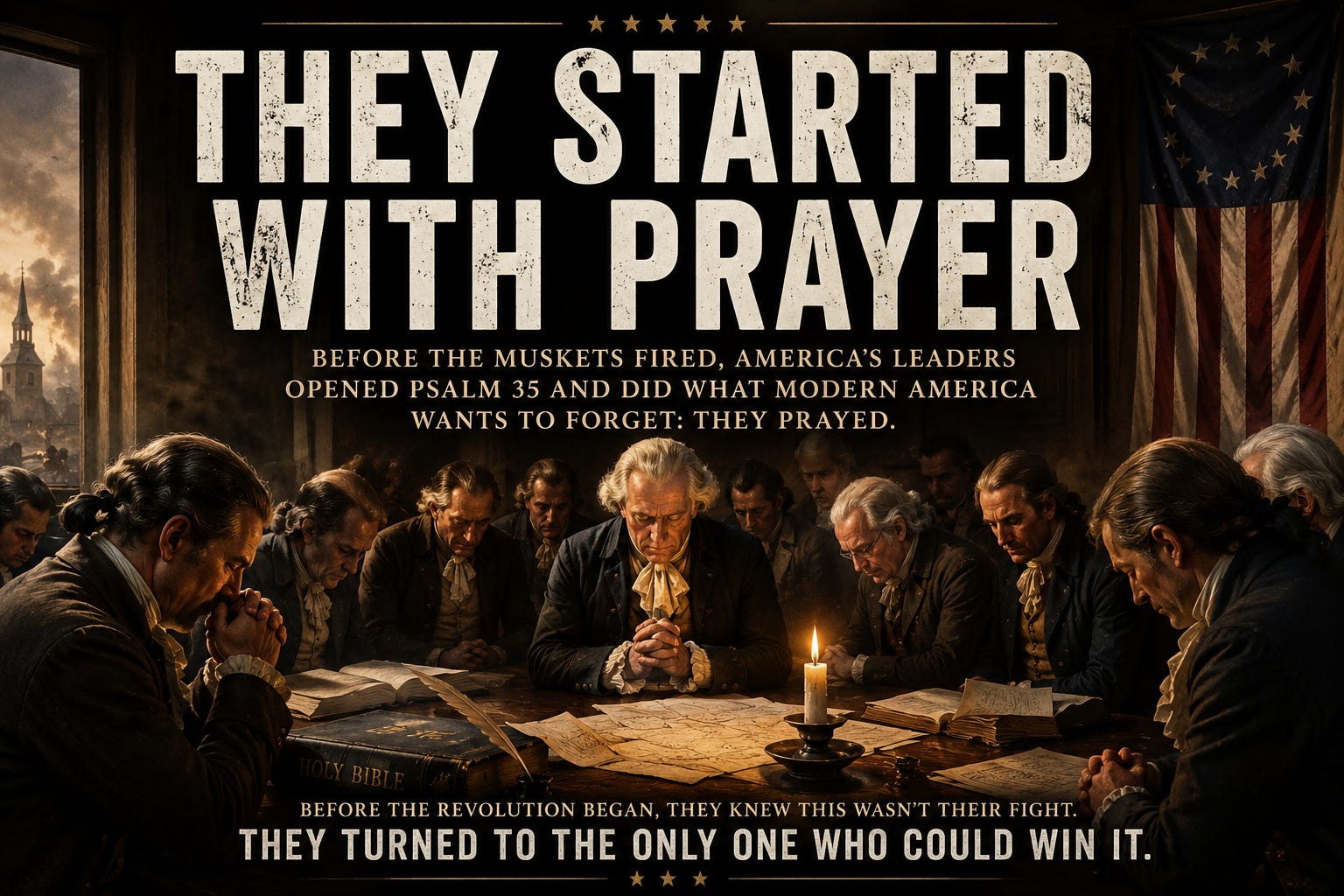
Before the muskets fired, America’s leaders opened Psalm 35 and did what modern America wants to forget: they prayed.

The Road to 250:
Rediscovering the people, principles, documents, and defining moments that forged the United States.
This is article three in my 250 series.
Now that America has entered its 250th year, I do not want to write a soft, safe, textbook version of our founding. We have plenty of that already. I want to go back to the real stories. The ones with blood in them. Prayer in them. Courage in them. Sacrifice in them. Men who stood when it would have been easier to bow. Men who failed. Men who endured. Men who believed liberty was worth suffering for.
But I also want to be clear about something.
When I talk about the founding of America, I am not only talking about the men whose names are carved into monuments.
Yes, we will talk about founding fathers, preachers, patriots, soldiers, statesmen, and the men who stood in the gap when tyranny came knocking. We should. But the American founding was also carried by wives who kept homes alive while husbands were gone, mothers who raised children under the shadow of war, women who organized boycotts, spun homespun cloth, wrote with moral clarity, raised money for soldiers, challenged cowardice, and paid the quiet costs of liberty that never make it into the paintings.
A nation is not built only by the men who sign declarations.
It is also built by the women who suffer, pray, write, sacrifice, teach, endure, and hold the world together while history is being made.
America was not born in a conference room by detached philosophers calmly drafting abstract political theory. America was born through conflict, conviction, providence, risk, repentance, sermons, petitions, muskets, fasting, prayer, and men and women who knew they were stepping into something much bigger than themselves.
And one of the most important things we can do in this series is strip away both lies.
The progressive lie says America was rotten from the beginning and should be despised.
The sentimental patriotic lie says America was perfect from the beginning and should never be examined honestly.
Both are false.
The truth is far more interesting. America was founded by flawed men and faithful women who were shaped by a deeply Christian moral imagination, who appealed constantly to Providence, who understood liberty as a gift from God, and who believed tyranny was not merely politically inconvenient, but morally evil.
That is why this story matters.
Before the Declaration was signed, before Washington commanded the Continental Army, before the Revolution became inevitable, the colonies gathered in Philadelphia under enormous pressure. They were divided by geography, denomination, temperament, strategy, and fear.
And then, before they knew exactly what to do, they did something modern America would probably mock.
They prayed.
But even that story is not as clean as most people think.
Because the prayer that helped unite the First Continental Congress was born, in part, from a rumor that was not even true.
They Prayed Over a City That Wasn’t Burning
Long before the first shots of the Revolution were fired, America’s leaders found themselves bracing for a war they believed had already begun.
That is the part of the story most people miss.
The most famous prayer in early American political history was not born in calm reflection. It was born in panic. The men who gathered in Carpenter’s Hall in Philadelphia in September of 1774 believed Boston may have already been attacked. They believed British ships may have opened fire on the city. They believed blood may already have been spilled in the streets.
None of that was true.
And that is exactly what makes the story so powerful.
Because God did not meet them in a clean, polished, sanitized patriotic moment. He met them in confusion. He met them in fear. He met them in a room full of men who did not fully trust each other, did not all worship the same way, did not yet agree on what resistance should look like, and did not even have all the facts straight.
And still, they prayed.
The Room Nobody Wanted to Pray In
The First Continental Congress met in Carpenter’s Hall on September 5, 1774. Fifty-six delegates from twelve colonies came to Philadelphia. Georgia did not attend. They were not there to declare independence. Not yet. In fact, many of them still hoped the relationship with Britain could somehow be repaired.
But Britain had pushed the colonies to the edge.
After the Boston Tea Party, Parliament passed the Coercive Acts, better known in America as the Intolerable Acts. Boston’s port was closed. Massachusetts’ self-government was gutted. British authority was tightened. The message from the Crown was clear.
Submit.
So the colonies sent men to Philadelphia to figure out what could be done.
The next day, Thomas Cushing of Massachusetts made a simple motion. He wanted Congress to open with prayer.
You would think that would have been easy in 1774.
It was not.
John Jay of New York objected. So did Edward Rutledge of South Carolina. Not because they hated God. Not because they were secular progressives before secular progressives existed. They objected because the room was a denominational minefield.
Episcopalians. Quakers. Anabaptists. Presbyterians. Congregationalists.
These were not minor differences to them. These were men who took doctrine seriously. They believed worship mattered. They believed truth mattered. And some of them were concerned that if Congress opened in prayer, it would immediately create a theological fight before they ever got to the political one.
Then Samuel Adams stood up.
This is the part that deserves to be remembered.
Samuel Adams was a Congregationalist from Massachusetts. He was no Anglican fanboy. But he said he was no bigot, and that he could hear a prayer from any man of piety and virtue who loved his country. He had heard good things about a young Anglican rector in Philadelphia named Jacob Duché, and he moved that Duché lead them in prayer the next morning.
Think about what just happened.
The man who would help light the fuse of revolution against the British Crown chose a priest from the Church of England, the king’s own church, to pray over the most important political gathering in the colonies.
That was not compromise without conviction.
That was unity under pressure.
Samuel Adams did not pretend their differences were fake. He did not flatten doctrine into some mushy religious sentiment. He simply understood that there are moments when men who disagree on lesser things must still kneel together before the God who rules over greater things.
That is not weakness.
That is wisdom.
The Psalm Nobody Planned
Jacob Duché arrived the next morning, September 7, at nine o’clock.
He came in full Anglican vestments, with his clerk beside him. He read the standard prayers from the Book of Common Prayer. Then he read the Scripture appointed for that day.
It was Psalm 35.
“Plead my cause, O Lord, with them that strive with me. Fight against them that fight against me.”
You cannot make that up.
John Adams later wrote to Abigail that the effect on the room was overwhelming. He said it seemed as if Heaven itself had appointed that psalm for that exact morning.
Then Duché did something no one expected.
He set the prayer book aside.
The Anglican priest went off script.
He began to pray extemporaneously, from his own heart, for America, for Congress, for Massachusetts, and especially for Boston.
The room broke.
Adams said the prayer filled the heart of every man present. Silas Deane later wrote that even Quakers, not exactly known for dramatic outward displays in worship, were moved to tears.
This was not a cute opening invocation before the real business began.
This was the first great spiritual moment of the American founding.
Before they formed an army, they prayed.
Before they declared independence, they prayed.
Before they knew what the future held, they prayed.
And they did it because they believed Providence mattered.
The Bombardment That Never Happened
Now here is where the story gets even more interesting.
The day before Duché prayed, the delegates had heard a terrifying report.
Boston had been attacked.
Or so they thought.
Six days earlier, on September 1, 1774, British General Thomas Gage sent troops to remove gunpowder from a powder magazine near Boston, in what is now Somerville, Massachusetts. The British took the powder. It was provocative. It was alarming. It was exactly the kind of move colonists feared.
But it was bloodless.
Nobody died.
Nobody fired a shot.
That did not stop the rumor from growing legs and sprinting through New England.
By the time the story spread, it had turned into something much larger. People heard that British troops had fired on civilians. Others heard that Boston had been bombarded by British warships. Some believed blood was already in the streets. Thousands gathered in Cambridge. Panic spread. Militias began moving toward Boston. The Revolution almost started seven months early because of a rumor.
Historians call it the Powder Alarm.
John Adams called the report a horrible rumor.
That rumor reached Philadelphia just before Duché prayed.
So when the delegates prayed in Carpenter’s Hall the next morning, they were not praying in some abstract patriotic mood. They were praying as men who believed their countrymen may already be dying.
But Boston was not burning.
The city had not been bombarded.
The report was false.
That means one of the most famous prayers in American history rose from a room full of men responding to incomplete and inaccurate information.
And still, God used it.
That should humble us.
Because we live in an age where people think misinformation is a new problem because it comes through a phone screen. It is not new. Rumor has always been one of the devil’s favorite accelerants. The only thing that changed is the speed.
In 1774, a false report traveled by horse.
Today, it travels by push notification.
But the human heart has not changed.
Fear still spreads faster than truth. Panic still feels more urgent than wisdom. Outrage still gathers a crowd before accuracy gets out of bed.
And yet, in that room, the founders did something many of us have forgotten how to do.
They did not merely react.
They prayed.
God Does Not Need a Perfect Moment
This is what I love about the story.
God did not wait until the delegates had perfect unity.
He did not wait until they had perfect information.
He did not wait until every theological difference was resolved.
He did not wait until their motives were pure, their courage was tested, or their strategy was clear.
He met them in the fog.
That is how God often works.
We want clean stories. God uses messy ones.
We want heroes without cracks. God uses sinners with trembling hands.
We want providence to look obvious in the moment. Most of the time, providence is only clear when you look back and realize God was holding the whole thing together while everyone in the room was trying not to fall apart.
The prayer at Carpenter’s Hall was not powerful because the men were perfect.
It was powerful because God was.
That is the difference between Christian history and sentimental patriotism.
Sentimental patriotism needs the founders to be flawless.
Christian history does not.
Christian history can tell the truth about flawed men because Christianity has never been built on the perfection of men. It is built on the sovereignty of God.
The Hero Who Did Not Stay One
And now we have to talk about Jacob Duché.
Because the ending of his story is the part most patriotic devotionals leave out.
Duché did not disappear after that prayer. He became a significant figure. Congress eventually elected him its first official chaplain in July of 1776, just days after independence was declared. Around that time, he and the vestry at Christ Church removed prayers for King George III from the liturgy, which was no small gesture for an Anglican minister who had been ordained under the authority of the Church of England.
That was dangerous.
That was bold.
That was treason in a clerical robe.
But Duché did not finish well.
In 1777, the British occupied Philadelphia. Duché stayed in the city. He was arrested. And when he emerged, something in him had changed.
He wrote a long letter to George Washington, who was then leading a battered army through one of the darkest seasons of the war. Duché urged Washington to give up the fight and seek peace with Britain.
Washington was appalled.
He forwarded the letter to Congress. It was published and spread through the colonies. The man once celebrated for praying over Congress became, in the eyes of many patriots, a traitor to the cause.
Duché fled to England. He did not return to Philadelphia until years later. He died in obscurity.
The man who prayed over America in one of her defining moments later tried to talk her out of enduring the cost of liberty.
That is not a clean story.
But it is a true one.
And true is always better than clean.
God Uses Men We Should Not Worship
Duché’s failure does not erase what God did through him in Carpenter’s Hall.
That matters.
Because some people only know how to do history in two ways. They either idolize men or destroy them. They either turn them into marble statues or smash the statues to dust.
The Bible gives us a better way.
Gideon was used by God and later made an ephod that became a snare. Samson was empowered by God and ruined by his appetites. Solomon was given wisdom beyond any king of his age and still allowed his heart to be dragged away. Peter preached at Pentecost and later had to be rebuked by Paul.
God has always used flawed men.
That does not excuse their flaws.
It magnifies His grace.
Duché’s prayer was real. His cowardice was also real. God used him in one hour, and he collapsed in another. That should not make us cynical. It should make us sober.
Being used by God is not the same thing as finishing faithful.
A powerful moment is not the same thing as a faithful life.
A man can pray with fire in September and fold under pressure three years later.
That should terrify every one of us in the best possible way.
What We Have Been Sold Versus What Actually Happened
There is one more thing worth saying.
The popular version of this story is often too polished.
You have probably seen the prayer quoted in full, beginning with, “O Lord our Heavenly Father, high and mighty King of kings.” The U.S. House Chaplain’s office preserves that version today. It is beautiful. It is deeply Christian. It names Jesus Christ directly.
But we should be honest about the historical record.
John Adams absolutely tells us that Duché read Psalm 35 and then prayed extemporaneously. He tells us the prayer was powerful. He tells us the men were deeply moved. That part is rock solid.
But the exact full text of Duché’s extemporaneous prayer was not printed in the official congressional journal that day like a transcript. It comes to us through later preservation and tradition. That does not mean it is fake. It means we should be careful.
The same is true of the famous painting showing the delegates kneeling in dramatic fashion. It is powerful art, but it was created decades later. It has shaped the popular imagination of the moment, but it is not a photograph. It is not eyewitness footage. It is an artist’s memory of a national memory.
And honestly, the real story does not need the embellishment.
The truth is strong enough.
A divided Congress really did stop to pray.
An Anglican priest really did read Psalm 35.
John Adams really did say the effect was extraordinary.
The delegates really were shaken by a rumor of war.
And God really did use that moment to unite men who were staring into the unknown.
That is enough.
Actually, it is more than enough.
What This Moment Should Teach Us
This story is not just a strange footnote from the founding era. It is a mirror.
It shows us something about America. It shows us something about the founders. But if we are honest, it also shows us something about ourselves.
Because we live in an age that knows how to react but has forgotten how to depend. We know how to panic. We know how to post. We know how to argue. We know how to spread a rumor, baptize our outrage, and call it courage.
But do we still know how to pray?
That is the question this moment forces on us.
The delegates in Carpenter’s Hall were not calm men sitting in a comfortable room with all the answers. They were divided. They were afraid. They were responding to alarming reports they did not yet fully understand. They did not know whether resistance would succeed. They did not know whether reconciliation was still possible. They did not know whether their names would be remembered as patriots or condemned as traitors.
So they prayed.
That alone rebukes our generation.
Because many Christians today treat prayer like a last resort instead of a first instinct. We pray after the strategy fails. We pray after the panic owns us. We pray after we have already forwarded the rumor, shared the outrage, and let fear disciple our hearts.
But prayer is not what the weak do because they have no plan.
Prayer is what the faithful do because they know no plan matters unless God governs it.
Prayer Is Not Passivity
One of the great lies of our age is that prayer is passive.
The men who prayed in Carpenter’s Hall were not using prayer as an excuse to avoid responsibility. Many of them would go on to risk their reputations, fortunes, families, and lives for the cause of liberty.
They prayed first because they knew action without dependence becomes arrogance.
That is a word the church needs badly.
We do not need less courage. We need courage that has been humbled before God. We do not need less conviction. We need conviction that has been tested by prayer. We do not need less boldness. We need boldness that flows from obedience, not ego.
There is a kind of activism that is just anxiety with a flag in its hand.
There is a kind of discernment that is just suspicion dressed up as wisdom.
There is a kind of boldness that is just pride with Bible verses taped to it.
Real Christian courage begins with dependence. Not because praying is the whole work, but because prayer reminds us who the real King is before we stand up and face the lesser kings of this world.
The founders did not pray because the fight did not matter.
They prayed because it did.
Christians Should Be the Hardest People to Manipulate
The Powder Alarm should hit us right between the eyes.
The report that helped shape the atmosphere of that prayer meeting was false. Boston had not been bombarded. Blood was not running in the streets. The city was not burning.
And yet thousands of men nearly mobilized for war because fear traveled faster than truth.
Sound familiar?
We like to think we are more advanced than the people of 1774 because our rumors travel through screens instead of on horseback. But the human heart has not changed. Fear still outruns wisdom. Outrage still moves faster than accuracy. A half-true headline still has more power over many people than a full chapter of Scripture.
That should not be true of Christians.
We should be the hardest people on earth to manipulate because we are commanded to be people of truth. We do not get to spread something simply because it helps our side. We do not get to pass along panic because it feels righteous. We do not get to confuse suspicion with discernment or speed with faithfulness.
A Christian who loves truth should care whether something is actually true.
The fact that a larger crisis is real does not make every rumor true.
That is a lesson for us.
The world wants to disciple you through fear. The algorithm wants to disciple you through outrage. Political movements want to disciple you through urgency. But Christ disciples His people through truth.
If we belong to Him, truth must matter more to us than being first, being loud, or being right in our own eyes.
Unity Does Not Mean Cowardice
There is another lesson in Carpenter’s Hall that we cannot afford to miss.
Those men were not the same. They did not share the exact same theological convictions. They did not worship in the exact same traditions. They did not all agree on strategy. Some wanted stronger resistance. Others still hoped for reconciliation.
And yet, in that moment, they found a way to pray together.
Modern people usually get unity wrong in one of two ways.
Some people think unity means pretending truth does not matter. That is cowardice. Biblical unity is never built by sacrificing conviction on the altar of getting along.
But other people are so addicted to division that they cannot recognize the difference between a primary issue and a secondary one. They turn every disagreement into a battlefield and call it faithfulness.
That is not courage either.
Samuel Adams understood something many people today have forgotten. You can have real convictions and still recognize a faithful ally. You can disagree on important things and still kneel before the same God in a moment of crisis. You can refuse compromise without becoming a small, suspicious person who cannot join hands with anyone unless they agree with you on everything.
The church needs that kind of maturity again.
Not fake unity.
Not spineless unity.
Not unity that avoids hard truths.
But unity among people who fear God more than they fear one another.
God Works Through Messy History
This moment also teaches us to stop demanding that history be cleaner than Scripture.
The Bible does not hide the failures of its heroes. Noah got drunk. Abraham lied. Moses struck the rock. David committed adultery and murder. Peter denied Christ. The Bible tells the truth because God is not threatened by truth.
So why are we?
Jacob Duché prayed one of the most moving prayers in early American history, and later he broke under pressure. That is the truth. His prayer was real. His weakness was real. God used him in one moment, and he failed in another.
That should make us sober.
A powerful moment does not guarantee a faithful life.
A courageous prayer does not guarantee endurance.
A person can be used by God and still fail to finish well.
That is not just a warning about Duché. It is a warning about us.
Do not assume yesterday’s courage will carry tomorrow’s obedience. Do not assume one bold stand means you are immune to fear. Do not assume because God used you once, you cannot collapse later.
Faithfulness is not proven in a moment.
It is proven over time.
The Prayer Modern America Wants to Forget
The real story of that first prayer in Congress is better than the legend.
Not cleaner.
Better.
Because it tells the truth.
They were afraid. They were divided. They were misinformed. They were uncertain. The man who led them in prayer would later falter. The moment was messy because history is messy, and men are messy.
But God met them there anyway.
Before the muskets fired, they prayed.
Before the Declaration was signed, they prayed.
Before America had an army, they prayed.
Before they knew whether the rumors were true, they prayed.
Before they knew whether they would win, they prayed.
And that is the part modern America wants to forget.
Because if America’s founders prayed before they acted, then maybe prayer was not an ornament on the edge of the founding. Maybe dependence on Providence was not a decorative phrase. Maybe the men who shaped this country did not believe liberty could survive without virtue, or virtue without God.
That is not mythology.
That is the record of what actually happened.
And maybe the reason this story still bothers modern people is because it cuts against the version of America they have been taught to believe.
We are told America was born from men who trusted only in reason, politics, power, and themselves.
But that is not what we see in Carpenter’s Hall.
We see men who knew they were standing at the edge of something too large for them.
So they opened Psalm 35.
They asked God for mercy.
They prayed before they acted.
America was not born from men who believed they were sufficient without God.
America was born, at least in moments like this one, from men who knew they were not.
And that may be the truth our generation finds most offensive.
Join the Inner Circle
If this kind of article matters to you, I want to personally invite you to join the Inner Circle!
The Inner Circle is for people who are tired of shallow Christianity, sanitized history, and cultural commentary that refuses to say what needs to be said. It is for men and women who want to think biblically, live courageously, and recover the truths our generation has been trained to forget.
This America 250 series is not just about looking backward. It is about remembering who we are, what shaped us, what we have lost, and what kind of courage it will take to be faithful now.
In the Inner Circle, we go deeper. I share premium articles, behind the scenes thoughts, private reflections, and hard conversations I cannot always fully unpack in public. We talk about theology, culture, history, politics, family, discipleship, and the issues many churches are too afraid to touch.
If you want to support this work and be part of a community that values truth over comfort, conviction over cowardice, and faithfulness over popularity, I would love for you to join us.
The world does not need more passive spectators.
The church does not need more silent men and women.
And this generation does not need softer voices.
It needs Christians who know what time it is, what they believe, why they believe it, and are willing to stand when standing costs something.
That is what we are building in the Inner Circle.
If that sounds like the kind of community you have been looking for, hit subscribe below and join us.
Chad, this is a great article! Thanks for leaving in the messy, accurate history. Nothing need ever be embellished or elevated to mythical status. I will be reading this to our staff today for today’s staff meeting devo. Blessings Brother and keep em’ coming! We get to do this!
I am not American, but I appreciate not only your struggle for liberty but also the faith and strength of faith that underpinned the move toward independence.
But more importantly, the article emphasizes our need to humble ourselves before God in everything, both great and small. We all struggle with this. I do. Too often God and prayer is the afterthought to the action. I am trying to be more consequent, but it's a fight that of itself requires prayer and contrition.
Anyway, thanks for this. I really enjoyed it on every level.