
The Declaration Was Not a Hallmark Card. It Was a Death Warrant.
Before America had a Constitution, she had a moral argument: our rights come from God, not government.

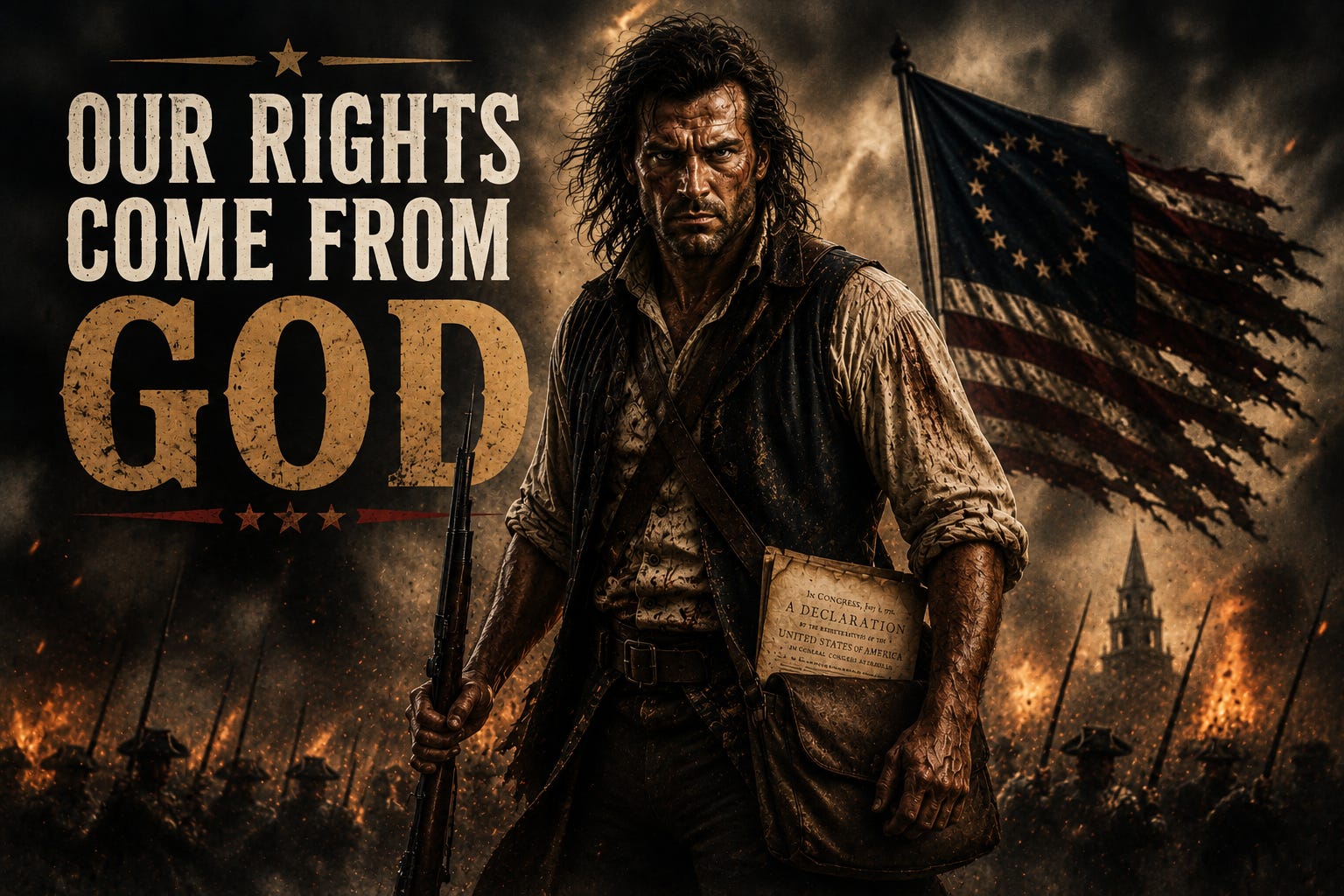
The Road to 250
This is the fourth article in The Road to 250: Rediscovering the people, principles, documents, and defining moments that forged the United States.
This series is not about nostalgia. It is not about pretending the founding generation was perfect. It is not about turning men into saints who never sinned, never compromised, and never contradicted their own stated ideals.
It is about remembering what they built, what they risked, what they believed, and why it still matters.
Because America did not begin with comfort. It did not begin with safety. It did not begin with everyone agreeing to get along. It began with conviction.
It began when a group of men looked at the most powerful empire on earth and said, in effect, there is a law above the king.
That sentence alone is revolutionary.
Before America had a Constitution, she had a Declaration. Before she had a functioning national government, she had a moral argument. Before she had a flag that could be recognized around the world, she had a truth that could not be erased.
All men are created equal.
Not all men are equally gifted. Not all men are equally wealthy. Not all men are equally wise. But all men are equally created by God, equally accountable before God, and equally possessing rights that no king, parliament, president, court, bureaucrat, mob, or majority has the authority to erase.
That is the atomic bomb at the center of the Declaration of Independence.
And if we are going to preserve America as we approach her 250th birthday, we had better recover the courage to say it again.
The Document We Have Turned Into Decoration
For many Americans, the Declaration of Independence has become little more than a July 4th decoration.
We print it on posters. We quote a few lines. We hear “life, liberty, and the pursuit of happiness,” eat a hot dog, watch fireworks, and move on with our lives.
But the men who approved this document were not celebrating a long weekend.
They were committing treason.
The Continental Congress adopted the Declaration on July 4, 1776. But the story did not begin there. Congress had appointed a five-man committee in June to prepare a declaration in anticipation of independence. That committee included Thomas Jefferson, John Adams, Benjamin Franklin, Roger Sherman, and Robert R. Livingston. Jefferson did most of the writing, Adams and Franklin suggested changes, Congress debated and revised the text, and the final Declaration was adopted on the afternoon of July 4. The parchment copy most people think of today was not signed that day by everyone. Congress ordered it engrossed on parchment on July 19, and the delegates began signing it on August 2. Eventually, 56 men signed.
That matters because the Declaration was not a spontaneous emotional outburst. It was not a mob chant. It was not a tantrum from entitled colonists who wanted to avoid responsibility.
It was a legal, moral, theological, and political argument.
They were telling the world why separation had become necessary.
They were telling King George III that his authority was not absolute.
They were telling Parliament that government exists to secure rights, not manufacture them.
They were telling the colonies that the point of this war was not merely survival, but liberty.
They were telling future generations that freedom is not a gift from the state.
It is a gift from God.
How America Got to This Moment
By the summer of 1776, the relationship between Great Britain and the American colonies had collapsed.
The colonists had spent years protesting taxation without representation. They objected to being treated as subjects to be managed rather than Englishmen with inherited rights. They had petitioned. They had pleaded. They had warned. They had appealed to the king.
And then the shooting started.
Lexington and Concord had already happened. Bunker Hill had already happened. Blood had already been spilled. The colonies were not debating political theory in an air-conditioned classroom. They were trying to decide whether they would submit to a crown that had already moved against them with force.
In August 1775, King George III issued a proclamation declaring the colonies to be in “open and avowed rebellion.” The possibility of easy reconciliation was disappearing fast.
This is where the story becomes important for Christians.
The Declaration was not written by men who woke up one morning and decided they hated authority.
That matters.
Romans 13 is real. Christians are not called to be anarchists. We are not called to be rebels by temperament. We are not called to despise all authority simply because authority frustrates us.
But Scripture also teaches that all human authority is delegated authority. God is supreme. Kings are not gods. Governments are not gods. Courts are not gods. Majorities are not gods.
When human authority commands what God forbids or forbids what God commands, Christians have always had to make a choice.
The Hebrew midwives had to choose. Daniel had to choose. Shadrach, Meshach, and Abednego had to choose. Peter and the apostles had to choose when they said, “We must obey God rather than men.”
That does not mean every inconvenience is tyranny. It does not mean every policy disagreement is persecution. But it does mean there is a point where submission to government becomes disobedience to God.
The founders believed the British government had crossed a line. They did not say it lightly. They laid out their case before God, before the king, before the colonies, and before the world.
The Committee of Five
The Declaration was shaped by five men, and one thing worth noticing is how young some of them were.
Thomas Jefferson was only 33 years old. John Adams was 40. Benjamin Franklin was 70, the elder statesman in the room. Roger Sherman was 55. Robert R. Livingston was just 29.
Think about that.
One of the most consequential documents in human history was not drafted by a room full of elderly men waiting safely at the end of their lives. Yes, Franklin was older, seasoned, and internationally respected. But Jefferson was in his early thirties. Livingston was still in his twenties. Adams was barely forty. These were not men sitting around protecting retirement accounts and reminiscing about better days. These were men with futures, families, reputations, careers, property, and everything still to lose.
Thomas Jefferson was the primary writer. He was young, gifted, brilliant, and deeply flawed. He could write words that would outlive empires, even while failing to fully live up to the meaning of those words.
John Adams was one of the fiercest advocates for independence. He was not the poet of the Revolution, but he was one of its engines. He understood that the colonies could not keep pretending reconciliation was likely while British power was being used against them.
Benjamin Franklin was the elder statesman, internationally respected, witty, practical, and wise. At 70 years old, he brought gravity to the committee. He had lived long enough to understand the cost, and yet he still stood with the cause of independence.
Roger Sherman of Connecticut was steady, principled, and often underappreciated. He was not as flashy as Jefferson or Franklin, but he was one of the most important founders in American history. Sherman would become the only man to sign all four major founding documents: the Continental Association, the Declaration of Independence, the Articles of Confederation, and the Constitution.
Robert R. Livingston of New York was the youngest of the five. He served on the committee but did not ultimately sign the Declaration because he was recalled by his state before the final signing. That detail reminds us the founding was messier than our paintings make it look.
These men were not identical. They did not all agree on everything. They were not all equally orthodox in their theology. Some were more recognizably Christian than others. Some held views and lived lives that Christians today should critique honestly.
What the Declaration Actually Says
But here is what cannot be denied.
They framed America’s birth certificate in explicitly Godward terms.
They did not ground human rights in government permission.
They did not ground human dignity in social consensus.
They did not ground liberty in the mood of the majority.
They appealed to the “Laws of Nature and of Nature’s God.”
That phrase matters.
The founders were saying there is a moral order built into the world itself. Right and wrong are not inventions of government. Justice is not whatever the king says it is. Human dignity is not created by a vote. There are truths woven into creation because creation has a Creator.
The “Laws of Nature” refers to the moral order that can be seen and understood through reason, conscience, human nature, and the created world. The “Laws of Nature’s God” reminds us that this moral order does not come from nowhere. It comes from God Himself. He is the Author behind creation, the Judge above kings, and the source of the rights government is supposed to protect.
That is why they said human beings are “endowed by their Creator with certain unalienable Rights.” Our rights are not favors handed down by rulers. They are gifts given by God. Government can recognize them. Government can protect them. Government can violate them. But government does not create them.
Then they appealed to the “Supreme Judge of the world.” In other words, their cause was not being laid only before Parliament, King George, or the court of public opinion. They were making their appeal before God Himself.
And they closed with “a firm reliance on the protection of divine Providence.” They knew they were stepping into danger. They knew independence could cost them their lives, fortunes, families, and futures. So they were not merely relying on strategy, speeches, muskets, or political momentum. They were entrusting the cause to the providential care of God.
That is what makes the Declaration so powerful. It does not begin with government. It begins with God. It does not say rights come from the state. It says rights come from the Creator. It does not place the king at the top of the moral universe. It places the king under the judgment of God.
That is not secular neutrality.
That is not atheistic political theory.
That is a nation being born under the shadow of God.
Then the Declaration explains government.
“To secure these rights, Governments are instituted among men, deriving their just powers from the consent of the governed.”
That sentence is a dagger through the heart of tyranny.
The founders were saying that government does not own the people. The people are not livestock. They are not property of the crown. They are not children of the state. They are human beings made in the image of God, possessing rights that existed before any government ever recognized them.
So where does government get its authority?
Not from divine kings.
Not from bloodlines.
Not from military power.
Not from elite permission.
Not from the arrogance of rulers who believe they were born to command everyone else.
Government receives its “just powers” from the consent of the governed.
That does not mean every individual gets everything he wants. It does not mean society has no laws. It does not mean rebellion is justified every time people dislike a policy, lose an election, or feel inconvenienced by authority.
It means legitimate government is accountable to the people because government exists for the people, not the other way around.
Consent of the governed means rulers are not masters. They are stewards. Public office is not ownership. It is a trust. Authority is not a blank check. It is delegated power with moral limits.
This idea was revolutionary because kings had often ruled as if the people existed to serve the crown. The Declaration flipped that upside down. It said government exists to secure the rights God gave to the people. If government protects those rights, it is doing its job. If government destroys those rights, it has betrayed its purpose.
That is why this line matters so much.
Government is not God.
Government is not the source of rights.
Government is not the parent of the people.
Government is not the savior of society.
Government is a servant with a job description.
Secure the rights God gave.
And when government becomes destructive of those rights, when it no longer protects life, liberty, conscience, property, justice, and the moral order necessary for a free people, the people are not morally obligated to pretend tyranny is legitimate forever.
That does not make Christians reckless revolutionaries. It does not give us permission to despise authority. Scripture teaches us to honor authority, pray for those in power, live peaceably as much as possible, and avoid the sinful spirit of rebellion.
But Scripture also teaches that all earthly authority is limited because all earthly authority sits underneath the authority of God.
The king is not ultimate.
The state is not ultimate.
The majority is not ultimate.
God is ultimate.
That is why “consent of the governed” matters. It places government beneath God and accountable to the people whose rights it was created to protect.
This is the argument.
This is the worldview.
God gives rights. Government secures rights. The people consent to government. And tyranny forfeits legitimacy when it destroys the very rights it exists to defend.
This Was Not Cheap Talk
We have to slow down here.
Because modern Americans are very good at posting brave words from safe places.
The founders did not have that luxury.
When they signed the Declaration, they were not adding their names to a harmless petition. They were publicly identifying themselves as enemies of the Crown. They had families. They had homes. They had farms. They had businesses. They had reputations. Many had wealth and status they could have protected by staying quiet.
Instead, they signed.
John Hancock was only 39 when he signed boldly as president of Congress. Benjamin Franklin, at 70, was the oldest signer. Edward Rutledge of South Carolina was just 26. These were not distant, untouchable legends. They were men of different ages and stations, all placing their lives, families, fortunes, and sacred honor on the line. The signers included lawyers, merchants, physicians, farmers, plantation owners, ministers, and public servants. The National Archives records the names, ages, occupations, families, and life details of the signers, which reminds us that these were not marble statues. They were husbands, fathers, sons, neighbors, and men with something to lose.
And some did lose dearly.
Francis Lewis of New York had his home ransacked after the British victory at the Battle of Brooklyn. His wife Elizabeth was arrested and imprisoned. According to the National Constitution Center, her imprisonment ruined her health, and she died in 1779.
Richard Stockton of New Jersey was captured and imprisoned by the British after signing the Declaration. His story has been debated in some details, but the basic fact remains, signing the Declaration placed men in real danger.
This is why the final line of the Declaration is not poetic filler.
“And for the support of this Declaration, with a firm reliance on the protection of divine Providence, we mutually pledge to each other our Lives, our Fortunes and our sacred Honor.”
Read that again slowly.
Lives.
Fortunes.
Sacred honor.
That is not branding.
That is covenant language.
They were saying, “If this fails, we may hang. Our families may suffer. Our property may be destroyed. Our names may be cursed. But we are bound together in this cause.”
We live in an age where people want the fruit of courage without the cost of courage.
We want freedom without sacrifice.
We want truth without consequences.
We want conviction without conflict.
We want leaders who will risk everything, while we risk nothing more than being misunderstood online.
The signers force us to ask a deeply uncomfortable question.
What do we actually believe strongly enough to suffer for?
The God of the Declaration
The Declaration is not the Bible.
That needs to be said clearly.
It is not inspired Scripture. It is not the gospel. It does not save sinners. It does not preach Christ crucified and risen. It does not explain the Trinity. It does not name Jesus Christ. It was written by flawed men, some of whom failed grievously to apply their own principles consistently.
So when I say the Declaration is theological, I do not mean it is a Christian creed, a church confession, a sermon, or a substitute for Scripture.
But it is still a profoundly theological document in the sense that its political argument rests on God, creation, moral law, human dignity, divine judgment, and Providence.
The Declaration assumes a moral order. It assumes creation. It assumes human dignity. It assumes divine judgment. It assumes Providence. It assumes there is a law above human law.
And that is exactly what our age is trying to destroy.
If rights come from God, government must be limited.
If rights come from government, government becomes god.
That is the whole battle.
The modern secular progressive left cannot preserve the Declaration’s meaning while denying its foundation.
It wants the language of rights without the God who gives them. It wants human dignity without the Creator who defines it. It wants equality without creation. It wants justice without a fixed moral law. It wants freedom while increasingly handing the state the power to decide what freedom means.
But once rights are detached from God, they become fragile.
If rights come from human consensus, then they can change when the consensus changes. If rights come from evolving social norms, then they can be rewritten every time the culture shifts. If rights come from the state, then the same state that gives them can take them away.
That is the danger.
The Declaration does not say our rights come from government approval, cultural fashion, academic theory, or activist pressure. It says we are “endowed by our Creator with certain unalienable Rights.”
That means there is a source of human dignity higher than the state.
There is a moral law higher than public opinion.
There is a Judge higher than the king.
And there are rights no government has the moral authority to erase.
You cannot easily keep the language of “created equal” if you no longer affirm a Creator who grounds that equality. You cannot speak of unalienable rights in the same way if those rights ultimately depend on human institutions to define and enforce them. And liberty becomes more fragile if the state is treated as the final moral authority rather than something accountable to a higher law.
Christians should understand this better than anyone.
Our ultimate citizenship is in heaven. Our ultimate King is Christ. Our ultimate hope is not America. But because Christ is King over all, we care about justice, truth, human dignity, and the moral limits of earthly power.
Christian patriotism, rightly ordered, is not worship of country.
It is gratitude to God for a nation built on principles worth preserving, repentance where we have failed those principles, and courage to defend them when they are under attack.
The Declaration Exposed America’s Contradictions Too
A serious Christian article on the Declaration cannot ignore the obvious.
The same nation that declared “all men are created equal” still permitted slavery. Some of the men who signed or shaped the founding owned slaves. The promise of the Declaration was not fully applied at America’s birth.
That is not an argument against the Declaration.
It shows that the Declaration did not excuse America’s sins. It exposed them.
But we also need to be honest about the world into which the Declaration was born. Slavery was not some uniquely American invention. It was tragically widespread across nations, empires, tribes, and civilizations throughout human history. By the 1700s, slavery and the slave trade were deeply embedded in much of the world’s economy and power structures.
That does not excuse it.
Sin is not less sinful because it is common.
But it does remind us that America’s founding happened in a world where slavery was still broadly practiced, defended, and tolerated. The miracle is not that America was born into a world untouched by slavery. It was not. The miracle is that America’s birth certificate contained the very principle that would eventually help destroy slavery’s moral legitimacy.
“All men are created equal.”
Those words did not instantly end slavery.
They did not immediately make America righteous.
They did not erase the hypocrisy of men who declared liberty while denying it to others.
But they did place a moral standard in the public square that slavery could not morally survive inside the American argument.
This is one of the reasons the Declaration matters so much. It gave future generations the moral language to confront America with her own creed. Abolitionists appealed to it. Abraham Lincoln appealed to it. Frederick Douglass wrestled with it. The words of the Declaration became a standard America could be measured against, even when America failed to live up to them.
That is the power of truth.
Truth does not flatter us.
Truth judges us.
It judges kings. It judges citizens. It judges founders. It judges nations. It judges us.
The Declaration did not make America perfect. But it gave America a standard higher than convenience, higher than economics, higher than politics, and higher than public opinion.
And once that truth was written down, it could not be buried forever.
If all men are created equal, then slavery is not merely unfortunate. It is a violation of creation.
If rights come from God, then no man has the moral authority to own another man made in God’s image.
If government exists to secure God-given rights, then government betrays its purpose when it protects the power of one man to steal the liberty of another.
That is why the answer to America’s failures is not to burn down the Declaration.
The answer is to repent where we have contradicted it and recover the moral courage to live up to it.
What This Document Set Into Motion
The Declaration did not end the war.
It intensified it.
It turned a colonial resistance movement into a public claim of nationhood. It told Britain that the colonies no longer sought mere reform. It told the world that these United Colonies were now free and independent states. It opened the door for foreign alliances. It gave the Continental Army a cause larger than survival. It gave ordinary citizens a reason to endure suffering.
The Constitution would come later.
The Bill of Rights would come later.
The long, painful battles over slavery, citizenship, religious liberty, civil rights, and constitutional limits would come later.
But the Declaration lit the fuse.
It announced that legitimate government rests on consent.
It announced that liberty is not the property of elites.
It announced that human rights are not gifts from rulers.
It announced that the king is under God.
That last point is the one tyrants hate most.
Because if the king is under God, the president is under God.
Congress is under God.
The Supreme Court is under God.
The governor is under God.
The mayor is under God.
The school board is under God.
The voter is under God.
I am under God.
You are under God.
There is no human authority high enough to escape divine accountability.
That is why the Declaration is still dangerous.
Why Christians Must Care
Some Christians today act as if caring about America’s founding is a distraction from the gospel.
And yes, it can become that.
If your hope is in America, your hope is too small.
If your savior wears a red tie or a blue tie, you need to repent.
If your Bible is wrapped in a flag in your heart, you have confused the kingdom of God with a nation that will one day pass away.
But the opposite error is also deadly.
Some Christians have become so afraid of idolatrous patriotism that they have embraced a kind of cowardly indifference. They act as if defending liberty, truth, family, religious freedom, and constitutional government is beneath the Christian life.
It is not.
Love of neighbor requires concern for the kind of nation our neighbors must live in.
Love of children requires concern for the kind of nation they will inherit.
Love of truth requires resistance to lies.
Love of God requires refusing to treat Caesar as lord.
The Declaration reminds Christians that earthly government has limits. It reminds us that our rights come from God, not the state. It reminds us that courage is costly. It reminds us that Providence matters. It reminds us that the moral order is real, even when rulers rage against it.
And it reminds us that there are moments when silence becomes surrender.
The Courage We Need Again
America does not need cowards with opinions.
We have plenty of those.
America needs men and women with conviction.
We need fathers who will teach their children that freedom is not free.
We need mothers who will raise sons and daughters with backbone.
We need pastors who will stop trimming the truth to keep the room comfortable.
We need churches that understand discipleship is not just helping people feel better about their private lives, but training them to obey Christ in public.
We need citizens who know the difference between liberty and license.
We need leaders who fear God more than polls.
We need Christians who understand that courage is not the absence of fear. Courage is obedience when fear is screaming.
The founders were not reckless men chasing chaos. They were not perfect men ushering in heaven on earth. They were men who saw a line and decided they could not keep backing up forever.
That is the lesson.
Every generation inherits lines it did not draw.
Every generation must decide which truths it will preserve.
Every generation must decide what it will tolerate, what it will confront, what it will pass on, and what it will surrender.
The Declaration declared that rights come from God.
Our generation must decide whether we still believe that.
The Declaration declared that government exists to secure those rights.
Our generation must decide whether we will allow government to redefine, regulate, ration, or erase them.
The Declaration declared that men could pledge their lives, fortunes, and sacred honor to a cause bigger than themselves.
Our generation must decide whether we still have sacred honor at all.
What It Will Take to Preserve It
We will not preserve the Declaration merely by quoting it.
We will preserve it by recovering the worldview beneath it.
That means recovering belief in the Creator.
It means teaching our children that they are made in the image of God, not stamped products of the state.
It means defending life because life is a gift from God.
It means defending religious liberty because conscience belongs to God before it belongs to government.
It means defending the family because the family existed before the state.
It means defending free speech because truth does not need permission from tyrants.
It means defending ordered liberty, not libertine chaos.
It means rejecting the lie that government can become father, mother, provider, priest, moral authority, and savior.
It means building communities strong enough to resist the spirit of the age.
It means telling the truth when the truth is costly.
It means refusing to surrender our children to ideologies that hate the God who gave them life.
It means Christians must stop asking, “What will this cost me?” before asking, “What does faithfulness require?”
The founders pledged lives, fortunes, and sacred honor.
Many Christians today will not even risk being disliked.
That has to change.
The Declaration Still Speaks
The Declaration of Independence is not merely an old document under glass.
It is a mirror.
It asks us whether we still believe rights come from God.
It asks us whether we still believe government has limits.
It asks us whether we still believe truth is higher than power.
It asks us whether we still believe courage is better than comfort.
It asks us whether we are willing to preserve what we inherited.
America is not eternal.
The kingdom of God is eternal.
But while we are here, in this nation, at this moment, with this inheritance, we are responsible for what we do with it.
The founders were not perfect.
But they were brave.
They were not sinless.
But they saw something true.
They did not build heaven.
But they gave us a nation rooted in the radical claim that our rights come from the hand of God, not the permission of man.
That idea is still worth defending.
That document is still worth reading.
That inheritance is still worth preserving.
And as we travel this Road to 250, we need to remember something.
America was not born because comfortable men wanted convenience.
America was born because courageous men were willing to risk everything for liberty under God.
The question now is whether we are willing to do the same.
Join the Inner Circle
If this series is stirring something in you, I want to invite you deeper.
The Inner Circle is not just about getting extra content.
It is not just a subscription tier.
It is a community.
It is a gathering place for Christ-loving truth seekers who refuse to drift with the spirit of the age, who want to think deeply, live faithfully, recover what has been forgotten, and encourage one another to stand with courage in an age of compromise.
Inside the Inner Circle, we are building more than an audience. I want to build a family of people who love Jesus, love truth, and are willing to wrestle honestly with the ideas, documents, people, and defining moments that have shaped not only America, but the modern world.
Because the questions raised in this series are bigger than one nation.
Where do rights come from?
What makes human beings valuable?
What happens when government forgets its limits?
What kind of courage does truth require?
These are not merely American questions. They are human questions. They matter whether you live in the United States, Canada, the United Kingdom, Australia, Europe, Africa, Asia, or anywhere else people are trying to preserve faith, family, freedom, and truth in a confused age.
If you believe this kind of work matters, I would be honored to have you join us.
For about $5, roughly the price of a cup of coffee, you can help support this work and become part of a community that is serious about faith, courage, history, and truth.
So if this article challenged you, encouraged you, or made you think, subscribe below and pick one of the paid tiers.
Your support helps me keep researching, writing, and creating articles, videos, and other content that tells the stories our generation desperately needs to remember before they’re forgotten.
And if this article encouraged you or challenged you, would you share it with someone else who needs to read it?
Share it with a friend. Text it to someone. Post it. Pass it on.
The Road to 250 is just getting started.
There are more stories to uncover, more heroes to rediscover, and more truths worth defending.
I hope you’ll walk the road with me!
Man!!!! I love these insights/reflections of history.
It's "Groundhog Day" and Time to Empty the Recycle Bins.Part One of Three Parts From generation to generation the past isprologue.
There is nothing new under the sun. "History doesn't just repeat itself ... it rhymes." (Mark Twain):
• Same language of law recycled
• Same unsustainable debts (at interest) recycled
• Same debt peonage (slavery) recycled
• Same premises of governing any population recycled
https://substack.com/@jt913/note/p-206465422?r=19ia12
Human Nature Does Not Change ... From Generation to Generation