
I Thought Comparing Hitler to Progressivism Was Insane. Then I Looked Into the History.
From eugenics and centralized power to ideological conformity, history reveals what happens when political movements try to redesign humanity.

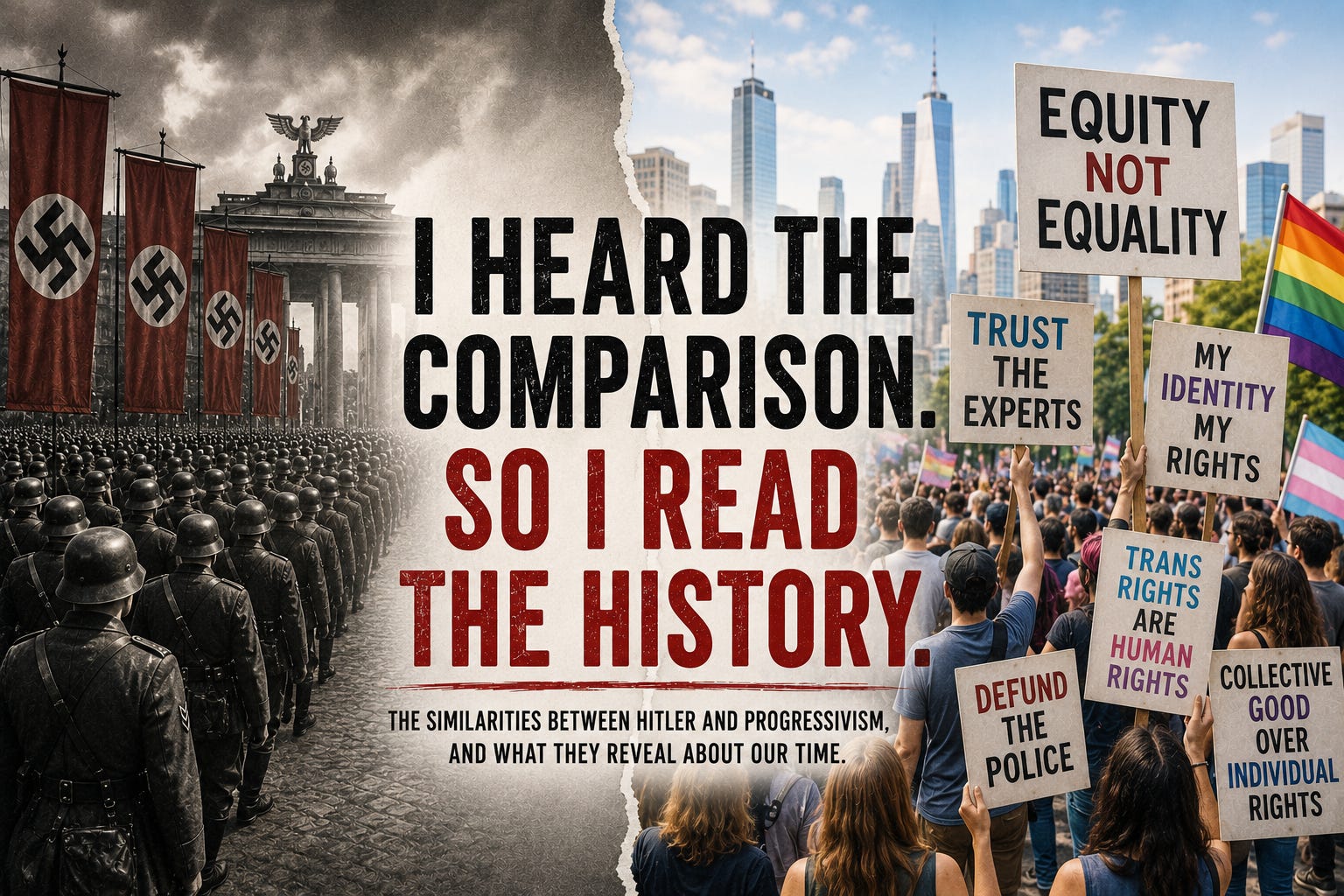
I Tested the Hitler Comparison. Here's What I Found.
I was recently listening to a podcast that made a comparison I’ve heard more than once over the past several years.
The hosts were discussing similarities between Adolf Hitler’s worldview and certain ideas found in modern politics.
My first reaction wasn’t agreement.
It was skepticism.
Let’s be honest. Comparisons to Hitler have become so common that they’ve almost lost their meaning. Every election seems to produce a new “He’s literally Hitler” headline. Every major political disagreement eventually ends with someone accusing the other side of being fascists or Nazis.
That kind of rhetoric doesn’t produce understanding.
It produces tribalism.
But it did make me curious.
So I decided to do something I wish more of us would do.
I went back to history.
So I went back to the original sources.
History books.
Speeches.
Government documents.
Firsthand accounts.
I wanted to know what these movements actually believed.
The more I read, the more I realized something important.
The real lesson of Nazi Germany isn’t that one modern political movement is secretly the Nazi Party.
The lesson is that dangerous ideas often reappear wearing different clothes.
History rarely repeats itself exactly.
But it often rhymes.
And if we refuse to recognize recurring patterns because we’re afraid of difficult conversations, history has very little to teach us.
Before We Go Any Further
Let me make something abundantly clear.
I am not interested in political tribalism.
I am a Christian who is conservative.
I am not a conservative who happens to be a Christian.
There’s a world of difference.
If tomorrow conservatism abandoned biblical truth, I wouldn’t follow conservatism.
I’d follow Christ.
My theology doesn’t bow to my politics.
My politics bow to my theology.
The Kingdom of God doesn’t belong to Republicans or Democrats.
It stands in judgment over both.
So this article isn’t about defending one political party while attacking another.
It’s about asking whether Christians are paying attention to history.
It’s also about asking why, for years now, so many Christians and conservatives have been casually labeled “Nazis” or “fascists.”
Those aren’t minor insults.
They’re accusations connected to one of the greatest evils in human history.
Eventually, I found myself asking a simple question.
If those labels are being thrown around this often
What ideas made these regimes so dangerous in the first place?
So I started reading.
And I found some uncomfortable truths.
Not because I discovered that everyone I disagree with is secretly a Nazi.
That would be ridiculous.
I found that certain ideas that have appeared in authoritarian movements throughout history deserve careful scrutiny whenever they reappear in any form.
Ideas matter.
Ideas shape cultures.
Ideas eventually become laws.
And laws shape civilizations.
What I’m Not Saying
Before anyone races to the comment section, let me save you the trip.
I’m not comparing personalities.
I’m not comparing lifestyles.
I’m not comparing appearances.
I’m comparing ideas.
I’m not comparing personalities.
I’m not comparing fashion.
I’m not comparing lifestyles.
I’m comparing ideas.
History is full of political movements that looked completely different on the surface while sharing similar assumptions underneath.
That’s why Christians study history.
Not to score political points.
So what patterns kept appearing?
As I worked through the history, I found several recurring characteristics that surfaced again and again in authoritarian movements. Not every regime exhibited them in exactly the same way, and no modern movement is identical to those of the twentieth century. But these ideas appeared often enough that I believe they’re worth paying attention to.
Here are the ones that stood out to me.
1. The Collective Above the Individual
One of the defining characteristics of twentieth-century authoritarian movements was the belief that the individual exists to serve the collective.
For Hitler, it was the German Volk.
The interests of the nation and the race came before the individual.
Rights were not viewed as inherent gifts from God.
They existed only insofar as the state permitted them.
Communist regimes embraced a remarkably similar principle, even though they despised fascism.
In the Soviet Union, Mao's China, Cambodia under Pol Pot, and elsewhere, millions suffered because the state claimed the collective mattered more than the individual. Families were torn apart, private property was confiscated, political dissidents were imprisoned or executed, and entire populations were subjected to famine, forced labor, and ideological purges. When the goals of the state became supreme, individual rights, human dignity, and even human life were often treated as expendable.
Different ideologies.
Different rhetoric.
The same dangerous principle.
The collective comes first.
That’s why a statement like this caught my attention.
In his inaugural address as mayor of New York City, Zohran Mamdani said:
“We will replace the frigidity of rugged individualism with the warmth of collectivism. If our campaign demonstrated that the people of New York yearn for solidarity, then let this government foster it.”
Now, let me say this as plainly as I can.
I’m not saying Zohran Mamdani is Adolf Hitler.
That would be absurd.
I am saying history teaches us to pay attention whenever political leaders celebrate collectivism while treating individual liberty as something cold, outdated, or undesirable.
Christians should especially pay attention because our worldview begins somewhere entirely different.
Human dignity doesn’t come from the state.
It doesn’t come from the collective.
It doesn’t come from the majority.
It comes from God.
Every human being is made in His image.
Government exists to protect those God-given rights, not redefine them.
Whenever the collective becomes more important than the individual made in God’s image, Christians should slow down and ask hard questions.
History has shown us where that road can lead.
2. The Expansion of Government Power
Authoritarian governments rarely begin by announcing they want absolute control.
They usually begin by promising solutions.
More security.
More equality.
More efficiency.
More justice.
People willingly surrender freedom because they’re told it’s temporary.
History tells a different story.
Power rarely shrinks voluntarily.
It almost always grows.
One of the defining characteristics of totalitarian regimes was the steady concentration of authority into fewer and fewer hands.
Independent institutions became obstacles.
Families.
Churches.
Local communities.
Private organizations.
Eventually, every competing authority had to yield to the state.
Christians have always believed government has an important role.
Romans 13 teaches that civil government is established by God to punish evil and promote justice.
But Romans 13 never teaches that government is God.
The Bible recognizes limits on civil authority because ultimate authority belongs to Christ.
Whenever government begins functioning as the highest moral authority in society, Christians should become cautious.
History reminds us why.
3. Censorship and the Fear of Open Debate
One objection I already know someone will raise is this:
“But conservatives ban books.”
I don’t think that’s an accurate way to describe what’s happening.
There is an enormous difference between banning a book from society and deciding that sexually explicit material does not belong in an elementary school library.
Many of the books at the center of these debates remain widely available in bookstores, online retailers, and public libraries.
Adults are free to purchase them.
The question isn’t whether adults should have access.
The question is what belongs in taxpayer-funded school libraries for children.
Reasonable people can disagree about where those lines should be drawn.
But that’s a different conversation from governments criminalizing possession of books or suppressing political viewpoints.
Historically, censorship looked very different.
The Nazi regime burned books.
It outlawed political opposition.
It controlled newspapers.
It criminalized dissent.
It imprisoned critics.
Authoritarian movements don’t merely disagree with opposing ideas.
They seek to make sure those ideas cannot be heard.
That instinct should concern Christians wherever it appears. Healthy societies answer bad ideas with better ideas, not with intimidation, coercion, or the silencing of those who disagree. The moment people become afraid to ask honest questions or express dissenting opinions, a culture has begun moving away from truth and toward control.
That is why Christians should be concerned whenever any culture begins treating disagreement as something that must be silenced instead of answered.
Truth has never needed censorship to survive.
Falsehood usually does.
Christianity has always spread through persuasion, proclamation, and sacrifice.
Jesus invited questions. The apostles reasoned in synagogues and marketplaces. The early church persuaded through truth, not through force.
Never through forcing consciences.
4. Identity Politics
In recent years, many influential voices on the political left have embraced forms of identity politics that divide society into categories of oppressors and oppressed. Race often becomes the primary lens through which history, justice, and even personal relationships are interpreted.
We’ve seen support for race-conscious admissions policies, Diversity, Equity, and Inclusion (DEI) initiatives that explicitly consider race, race-based affinity groups, and the growing tendency to explain success, failure, privilege, or oppression primarily through racial identity.
While many advocates argue these efforts are intended to address historical injustice rather than assign personal guilt, they still encourage people to see one another first as members of racial groups instead of as unique individuals.
That should concern Christians.
The Bible teaches that every person is made in the image of God. We all descend from one man, Adam. We are all equally fallen, and we all stand equally in need of the grace found in Jesus Christ.
The gospel does not divide humanity into permanent categories of oppressor and oppressed.
It divides humanity into two groups:
Those who are in Adam.
And those who are in Christ.
5. Hostility Toward Christianity
Despite occasional political alliances with churches, Hitler ultimately viewed historic Christianity as an obstacle.
Why?
Because Christianity recognizes an authority higher than the state.
If Caesar commands what God forbids, the Christian must obey God rather than men.
That conviction has made faithful Christians a thorn in the side of authoritarian governments for two thousand years.
The early Christians refused to worship Caesar.
The confessing church resisted Hitler.
Believers were imprisoned under communist regimes for refusing to surrender their allegiance to Christ.
Totalitarian movements rarely tolerate rival authorities.
That is one reason I find it interesting that we constantly hear calls for tolerance, inclusion, and diversity of thought until a Christian simply expresses beliefs that have remained remarkably consistent for nearly two thousand years.
Suddenly, tolerance has limits.
Believe that marriage is between one man and one woman?
You’re called hateful.
Believe that God created us male and female?
You’re labeled intolerant.
Believe that Jesus is the only way to the Father?
You’re accused of bigotry.
The irony is difficult to miss.
The culture celebrates almost every worldview except the one that has remained anchored while every cultural trend has come and gone.
Christianity has outlived emperors, kingdoms, revolutions, dictators, and political parties.
Its core doctrines have not changed because they are not determined by opinion polls, election cycles, or whatever happens to be fashionable this decade.
As Christians, we don’t measure truth by what is popular.
We measure popularity by what is true.
That doesn’t mean Christians should be rude, hateful, or arrogant.
We are commanded to speak the truth in love.
But love does not require us to change God’s Word every time culture changes its mind.
History teaches us that governments often become uncomfortable with people whose highest allegiance belongs to someone they cannot control.
That is why faithful Christianity has so often found itself in conflict with authoritarian power, regardless of whether that power comes from the right or the left.
6. Eugenics and the Value of Human Life
Long before the Holocaust, eugenics had become fashionable across much of the Western world.
The basic idea was chillingly simple.
Some lives were considered more valuable than others.
Some people should reproduce.
Others should not.
The Nazis didn’t invent eugenics.
They embraced it and carried it to its horrific conclusion.
But they weren’t alone in believing that society could be improved by determining which lives were worth protecting.
That same worldview found supporters in America as well.
Margaret Sanger, the founder of Planned Parenthood, openly embraced many of the ideas of the American eugenics movement. She argued for preventing those she considered “unfit” from reproducing and worked alongside leading eugenicists of her day.
One example often discussed is the Negro Project, launched in 1939 to expand birth control services in predominantly Black communities in the South. Sanger insisted that Black physicians and ministers should help lead the effort because she believed the program would be more readily accepted if it came from trusted members of the community. Critics argue that the project reflected the eugenic belief that reducing birth rates among the poor and other groups deemed “unfit” would improve society, while defenders contend its primary goal was to increase voluntary access to birth control rather than to target Black Americans as a race.
Whatever Sanger's precise motives in that particular project, there is little serious dispute that she embraced eugenics, spoke at eugenics conferences, associated with leading eugenicists, and advocated restricting reproduction among those she considered "unfit." Eugenic thinking was not incidental to her world; it influenced both her work and the broader birth control movement of her time.
As Christians, that should trouble us.
Because the moment society begins assigning different levels of value to different human beings, we’ve already abandoned the biblical view of humanity.
That brings us to today.
The abortion debate is often framed as a question of choice.
But underneath it lies a deeper question.
Does an unborn child possess inherent human worth?
Scripture answers that question with a resounding yes.
God knew Jeremiah before he was born.
John the Baptist leaped in his mother’s womb.
David declared that God knit him together in his mother’s womb.
The unborn are not potential people.
They are people with potential.
Yet millions of unborn children have lost their lives because our culture has concluded that their value depends on whether someone else wants them.
That should sound familiar.
Every society that has embraced eugenic thinking has eventually concluded that some human lives matter more than others.
The categories change.
The justification changes.
But the underlying principle remains the same.
Christians reject that entire way of thinking.
The elderly man with dementia.
The child with Down syndrome.
The disabled veteran.
The unborn baby.
The poor.
The wealthy.
The healthy.
The sick.
Every one of them bears the image of God.
Their value is not determined by intelligence, race, productivity, stage of development, or whether they are convenient.
Their value is determined by the God who created them.
That is one of the clearest dividing lines between biblical Christianity and every ideology that measures human worth by usefulness.
7. Christianity Offered a Better Way
It’s easy to spend an entire article talking about what Christianity opposes.
But we should also remember what Christianity has built.
Long before the modern world spoke about human rights, Christianity taught that every man, woman, and child was created in the image of God.
Long before governments established hospitals, Christians were caring for the sick, the poor, the orphan, and the widow.
Long before abolition became politically fashionable, Christians like William Wilberforce argued that slavery was incompatible with the gospel because every human being possesses equal worth before God.
Christianity transformed the way the world viewed children, women, the disabled, and the forgotten. It taught that kings and beggars alike would one day stand before the same Judge. That truth leveled humanity in a way no political revolution ever could.
It also shaped the Western understanding of limited government.
The state is not God.
Caesar is not Christ.
Government has a God-given role, but it is not the source of our rights, our dignity, or our salvation.
Those belong to God alone.
That is why biblical Christianity has so often found itself at odds with authoritarian governments throughout history.
Not because Christians seek political power.
But because they refuse to grant the state the authority that belongs only to God.
Every society is ultimately built on a vision of what it means to be human.
Authoritarian ideologies ask what people can contribute to the collective.
The gospel begins with a different question.
Who does God say this person is?
The answer changes everything.
8. Political Violence
Political violence does not begin with fists or bullets.
It begins with words.
It begins when people stop seeing their opponents as neighbors and start seeing them as enemies who must be defeated at any cost.
The twentieth century is filled with examples. Before authoritarian regimes imprisoned, exiled, or executed political opponents, they first spent years convincing ordinary people that those opponents were dangerous, hateful, or less than fully human.
History teaches that violence rarely erupts out of nowhere.
It is usually preceded by propaganda, dehumanization, and the belief that some people deserve to be silenced rather than answered.
That is why Christians should be deeply concerned whenever public discourse begins treating political opponents as existential threats rather than fellow human beings.
Words shape the way people think.
The way people think shapes the way they act.
If a culture repeatedly tells people that their political opponents are the moral equivalent of Hitler or Nazis, it should not surprise us when a few unstable individuals begin to believe they have a moral duty to stop them by any means necessary.
History has shown us where that kind of rhetoric can lead.
We have already begun to see signs of that spirit in our own culture.
In 2023, former NCAA swimmer Riley Gaines was forced to shelter in a classroom at San Francisco State University after protesters surrounded the area following her speech. Campus police later escorted her to safety. Whether someone agrees with her views or opposes them is beside the point. No one should have to barricade themselves in a classroom simply for expressing an opinion.
We’ve also heard elected officials encourage increasingly confrontational tactics. In 2018, Representative Maxine Waters urged supporters, “If you see anybody from that Cabinet in a restaurant, in a department store, at a gasoline station, you get out and you create a crowd. And you push back on them. And you tell them they’re not welcome anymore, anywhere.”
More recently, the assassination of Charlie Kirk exposed something even darker. While millions mourned the murder of a husband, father, and public figure, others openly celebrated his death online, mocked him, and treated his killing as a political victory.
That should grieve every Christian.
Our response to the murder of someone with whom we disagree should never be celebration.
It should be sorrow.
Christians reject political violence regardless of who commits it or who the victim is.
We do not answer speech with threats.
We do not answer disagreement with mobs.
We do not answer bad ideas with bullets.
The gospel commands us to love our enemies, pray for those who persecute us, and overcome evil with good.
Ideas should be defeated with truth.
Arguments should be answered with better arguments.
People are made in the image of God, even when they are profoundly wrong.
That is the Christian way.
And it is the only path that breaks the cycle of hatred and violence.
9. Propaganda
Joseph Goebbels, Adolf Hitler’s Minister of Propaganda and one of the chief architects of the Nazi regime’s information machine, understood something every authoritarian understands.
Control the narrative, and you can often control the people.
He famously observed that if you repeat a lie often enough, people will eventually believe it. Whether or not every version of that quote is authentic, the principle certainly was. The Nazi regime saturated Germany with one approved narrative while suppressing competing voices.
That’s why Christians should become nervous whenever one viewpoint becomes almost impossible to question.
History reminds us that healthy societies benefit from genuine debate. Whenever influential institutions begin discouraging dissent rather than engaging it, Christians should pay close attention.
History teaches us that propaganda doesn’t always begin with outright lies.
It often begins by deciding which questions are no longer allowed to be asked.
Who gets to define “misinformation”?
Who decides which opinions are too dangerous to hear?
Who determines which experts may speak and which must be silenced?
Those questions matter because today’s “dangerous misinformation” has often become tomorrow’s accepted truth.
Science advances because ideas are tested.
Justice advances because authority is challenged.
The gospel spread because ordinary men refused to stop speaking when governments told them to be quiet.
As Christians, our loyalty is not to the official narrative.
It is to the truth.
And truth does not become false because it is unpopular.
Nor does falsehood become true because everyone repeats it.
What I’m Not Saying
If you’ve read this far, let me be clear about what I’m not arguing.
I’m not saying every progressive is a Nazi.
That would be historically inaccurate, unfair, and intellectually lazy.
Many people on the left genuinely want to help the poor, pursue justice, and make society better. I don’t question that many of their motives are sincere.
Good intentions, however, do not guarantee good outcomes.
History teaches us that some of the darkest chapters in human history were written by people who believed they were building a better world.
That’s why we must judge ideas not merely by their intentions, but by the principles they’re built upon and the fruit they ultimately produce.
My concern isn’t with labels.
It’s with patterns.
When I see increasing hostility toward free speech, the elevation of the state over the individual, the division of people into competing identity groups, the devaluing of unborn human life, and pressure to conform to an approved cultural narrative, I don’t think it’s hateful to ask where those ideas have led before.
I think it’s responsible.
The purpose of studying history isn’t to score political points.
It’s to recognize dangerous patterns before they become dangerous realities.
Authoritarianism almost never introduces itself as tyranny.
It arrives promising safety.
It promises equality.
It promises fairness.
It promises compassion.
It promises progress.
And because those promises sound noble, people often fail to notice what they’re being asked to surrender in return.
History is full of civilizations that believed, “That could never happen here.”
Most of them were wrong.
The greatest danger isn’t asking hard questions. It’s losing the courage to ask them at all.
Why Christians Should Care
The Bible teaches that human beings are sinful.
That means no government can be trusted with unlimited power.
Rights come from God, not the state.
Human dignity comes from being made in the image of God, not from usefulness, identity, or political allegiance.
And truth is never established by force.
History is worth studying because it teaches us to recognize patterns before they become tragedies.
If we only recognize tyranny after it has fully arrived, we have learned history far too late.
That is also why I don’t believe Christians can afford to remain silent when reckless accusations are thrown around without evidence.
For years, many conservatives and Christians have been casually labeled “Nazis,” “fascists,” or “authoritarians” simply for holding convictions that Christians have believed for centuries.
Those are not harmless insults.
They are serious historical accusations.
When those labels are repeated often enough, they begin to shape how people think. They poison conversations before they begin. They encourage people to dismiss biblical convictions without ever honestly engaging them.
Even more concerning, they can push people away from Christ and His church by convincing them that historic Christianity is somehow synonymous with oppression or fascism.
That should grieve every believer.
Our calling is not to become political combatants.
Nor is it to become doormats who quietly accept falsehoods for the sake of appearing nice.
Our calling is to speak the truth in love.
Sometimes that means correcting false accusations.
Sometimes it means reminding people what history actually says.
Sometimes it means defending biblical truth even when doing so is unpopular.
Not because we want to win political arguments.
But because we love our neighbors enough to care whether they believe what is true.
Jesus never called His followers to be obnoxious.
But He never called us to be silent either.
The church is at its best when it is both courageous and compassionate.
Conviction without love becomes self-righteousness.
Love without conviction becomes compromise.
The gospel calls us to both.
So let’s study history honestly.
Let’s reject authoritarianism wherever it appears.
Let’s refuse lazy labels and reckless comparisons.
And above all, let’s remember that our highest allegiance is not to a political party, an ideology, or a nation.
It is to the King whose kingdom will outlast them all.
Share This Article
If you found this article helpful, would you do me a favor?
Please share it with a friend, post it on social media, or send it to someone who enjoys thoughtful conversations about faith, history, and culture. The algorithms won’t do this work for us, but faithful people can.
Every share helps more people think biblically about the world around them.
Join the Inner Circle
If this article challenged you, encouraged you, or simply made you stop and wrestle with some of your assumptions, I’d love to invite you to join the Inner Circle!
For just $5 a month, you’ll become part of a growing community of Christians committed to pursuing truth with conviction, humility, and courage.
The Inner Circle isn’t an echo chamber.
It’s a community of Christians who care more about truth than tribalism, Scripture than slogans, and conviction than convenience.
Every week we go deeper than I can in a public article. We tackle difficult theological questions, cultural issues, church history, apologetics, and the challenges facing Christians today. You’ll also receive an exclusive weekly article, access to our private Telegram community, monthly Zoom discussions, voice notes, prayer requests, and behind the scenes content.
If you’re tired of shallow Christianity and shallow politics, this community is for you.
If you want thoughtful conversations rooted in Scripture rather than talking points, you’ll feel right at home.
If you want to grow in your faith while learning to think biblically about the world around you, I’d love to have you with us!
History reminds us that every generation must decide whether it will simply inherit the truth or courageously contend for it.
Let’s be the generation that does both.
Join the Inner Circle today. I’d be honored to walk that journey with you.
Chad! Excellent piece!
...something different about your wording. Really cuts through the rhetoric.
Really scary premise ...
Side-note and little pet peeve of mind: I'd like to enforce rules for politicians that their campaign speeches can only be about what they're going to change and how.
NOT smearing their opponent.
See what they have to say then!
They ALL sound like 6th graders with the finger pointing, whining, "He did, he didn't...."
A few years ago, I began studying these same concepts, Chad. I was concerned about how readily the labels “Nazi” and “Fascist” were thrown around. Mostly, because having taught history, I knew how little the present generation understood their true meaning or the history surrounding them. They were being regurgitated without any true regard for their origins. That scared me. Because taken out of context, labels become weapons. In the hands of ignorance they become a battle cry with no regard to what they actually point to.
This article very plainly describes the fallacy of that and the danger. It’s also a call to action for every Christian who believes in the Word of God. The labels crumble under the weight of truth. And for that I applaud your dedication to the important task you’ve undertaken here, and in your Road to 250 series. Your voice rings with the truth of God’s Word. And that is the armor we’re all called to don!